Blog > Palm Coast Property Taxes, Homestead Exemption and the Save Our Homes Cap: What Every Buyer Must Know in 2026
Palm Coast Property Taxes, Homestead Exemption and the Save Our Homes Cap: What Every Buyer Must Know in 2026
by
Palm Coast Property Taxes, Homestead Exemption, and the Save Our Homes Cap: What Every Buyer Must Know in 2026
One of the most common questions buyers ask when relocating to Palm Coast is, "What will my property taxes actually be?" It is also one of the most misunderstood. The number on the current tax bill you see in the listing is almost certainly not what you will pay after you close. Florida's property tax system has moving parts—the homestead exemption, the Save Our Homes assessment cap, portability from a previous Florida home, and a major ballot amendment heading to voters this November—and understanding all of them can save you thousands of dollars per year.
This guide breaks down every piece of the property tax puzzle for Palm Coast and Flagler County buyers in 2026, with real numbers so you can budget accurately before you make an offer.
For a broader look at the Palm Coast and Flagler Beach markets, visit our Flagler Beach and Palm Coast Real Estate Market Report.
What Buyers Need to Know About Palm Coast Property Taxes Before Closing
Palm Coast is located in Flagler County, which consistently has one of the lower effective property tax rates in Florida. The county's median effective tax rate is approximately 1.05%, compared to Florida's statewide median of 1.10%. That modest difference translates to real savings on a $400,000 home - and the gap grows even wider once your homestead exemption kicks in.
But here is the critical thing most buyers do not realize: the tax bill you see on a listing reflects what the current owner pays based on their assessed value, their exemptions, and how long they have owned the property. When you purchase the home, all of that resets. Your first-year tax bill as a new owner will typically be higher - sometimes significantly higher - than the previous owner's bill. Understanding why this happens is the first step to budgeting correctly.
How Palm Coast's Effective Tax Rate Compares to Other Florida Markets
Palm Coast buyers benefit from lower tax rates than most major Florida coastal markets. While Miami-Dade, Broward, and Palm Beach counties carry effective rates of 1.0% to 2.0% on higher assessed values, Flagler County properties are assessed at lower base values with a median effective rate under 1.1%. Combined with Florida's lack of a state income tax, the overall tax burden for Palm Coast homeowners is genuinely favorable compared to most of the country.
Within Palm Coast, effective rates vary slightly by ZIP code. Homes in the 32137 ZIP code carry a median effective rate of approximately 1.08%, while properties in the 32164 ZIP code average closer to 0.97%. The difference is due to school district boundaries and local special assessment districts that apply in some parts of the city.
How the Total Millage Rate Is Calculated in Flagler County
Your annual property tax bill is calculated by multiplying your property's taxable assessed value by the total combined millage rate for your location. The millage rate is expressed as dollars per $1,000 of taxable value and is made up of several separate levies stacked together.
For Palm Coast homeowners in 2026, the components include the City of Palm Coast levy, the Flagler County levy, the Flagler County School District levy, and any applicable special district assessments. Palm Coast City Council approved a maximum millage rate of 4.2296 for the 2026-2027 budget cycle, though the final adopted rate may be lower. Combined with county and school levies, total millage in most of Palm Coast runs between 14 and 17 mills depending on your specific location and applicable districts.
For the exact millage rate that applies to a specific property, visit the Flagler County Tax Collector's property tax page and look up the parcel directly.
Florida's Homestead Exemption Explained for Palm Coast Buyers
Florida's homestead exemption is one of the most generous primary residence tax benefits in the country. As a Palm Coast buyer who will occupy your home as a primary residence, it can reduce your taxable assessed value by up to $50,000 and lock in long-term protection against rising assessments through the Save Our Homes cap. Here is exactly how it works.
The First $25,000 Exemption
The first $25,000 of your home's assessed value is completely exempt from all property taxes - county, city, school district, and all special districts. This is the base exemption every qualifying Florida homeowner receives. On a home with a taxable value of $350,000, this first exemption alone reduces your taxable base to $325,000.
The Second $25,000 Exemption
A second $25,000 exemption applies to the portion of your assessed value between $50,000 and $75,000. This second exemption applies to all taxes except the school district levy. For 2026, the combined homestead exemption totals $51,411 when adjusted for inflation indexing. For a home assessed at $350,000, the combined exemptions reduce your non-school taxable value by $50,000 and your school taxable value by $25,000, producing meaningful savings across both categories.
How Much Does the Exemption Actually Save You
At a combined millage rate of approximately 15 mills (a reasonable midpoint for most of Palm Coast), the full $50,000 homestead exemption saves you roughly $750 per year compared to a non-homesteaded property at the same assessed value. That savings compounds every year you own the home. Over a 10-year ownership period, the exemption alone saves you $7,500 or more - before accounting for the even larger benefit of the Save Our Homes cap described below.
How to File for Homestead Exemption in Flagler County
To claim the homestead exemption on your Palm Coast home, you must apply with the Flagler County Property Appraiser's office. The process requires that you:
1. Own the home and occupy it as your primary residence as of January 1 of the tax year you are applying for. 2. Provide proof of Florida residency, such as a Florida driver's license or vehicle registration with your new address. 3. Submit your application to the Flagler County Property Appraiser at (386) 313-4150 or online at flaglerpa.com. 4. File by the March 1 deadline to receive the exemption for that tax year.
The March 1 Deadline You Cannot Miss
This is the detail that catches the most new Palm Coast homeowners off guard. If you close on your home in, say, October 2026, your homestead exemption will not take effect until the 2027 tax year - and only if you file your application by March 1, 2027. Your 2026 tax bill (sent in November 2026) will be calculated at full assessed value with no exemption. Plan your first year's tax budget accordingly. The good news: once you file and are approved, the exemption renews automatically every year as long as you continue to own and occupy the home as your primary residence.
The Save Our Homes Cap - Your Most Valuable Long-Term Tax Protection
The homestead exemption saves you money from day one, but the Save Our Homes cap is what protects Palm Coast homeowners over the long term. In a rising real estate market, this cap is worth far more than the exemption itself.
How the 3% Cap Works
Once your homestead exemption is in place, Florida's Save Our Homes Amendment limits how much your property's assessed value can increase each year. The cap is the lesser of 3% or the Consumer Price Index (CPI) for that year. For 2026, with inflation running below 3%, the cap is 2.7%. This means that even if your Palm Coast home's market value increased by 8% last year, the assessed value used to calculate your tax bill can only rise by 2.7%. The gap between your market value and your assessed value is called the SOH differential, and it grows larger every year you own the home. For long-term Palm Coast owners, this gap can represent tens of thousands of dollars in assessed value that is completely shielded from taxation.
The Flagler County Property Appraiser's Save Our Homes page explains how the cap is applied to individual parcels and includes examples of how the differential builds over time.
What Happens to the Cap When a Property Sells
Here is the most important thing every Palm Coast buyer needs to understand: when a property sells, the Save Our Homes cap resets. The new owner's assessed value starts at the full current market value. There is no transfer of the previous owner's cap to the buyer. This is why the tax bill in the listing is almost always lower than what you will pay - sometimes dramatically lower if the previous owner has been in the home for 10 or 20 years and built up a large SOH differential.
As a buyer, you can request the current assessed value and SOH differential for any property from the Flagler County Property Appraiser's office before making an offer. Knowing the gap between the current assessed value and the current market value tells you exactly how much your tax bill will increase after closing compared to what the seller is paying today.
The Tax Bill Shock Buyers Must Prepare For
Consider this example: a Palm Coast homeowner bought their home in 2010 for $180,000. Today it is worth $380,000. Thanks to the Save Our Homes cap, their assessed value has only grown to $240,000 over 16 years. Their tax bill is calculated on $240,000 minus their homestead exemption. You purchase the home at $380,000. Your first tax bill after the exemption is applied will be calculated on roughly $330,000 - a $90,000 higher taxable base than the seller was paying on. At 15 mills, that difference is $1,350 more per year. This is not a flaw in the system - it is how the cap is designed. Budget for it, and remember that once your own cap kicks in after your first year of homestead, your assessments will also be limited to 3% going forward.
For an overview of current values across the market, see our latest market report.
Florida Homestead Portability - Taking Your Savings With You
If you previously owned a homesteaded property in Florida and are buying in Palm Coast, you may be able to transfer your accumulated Save Our Homes benefit to your new home. This is called portability, and it can dramatically reduce your taxable value in the first year of ownership.
What Portability Is and Who Qualifies
Florida homestead portability allows you to transfer up to $500,000 of your accumulated SOH differential from your previous Florida homestead to a new one. For example, if your previous Florida home had a market value of $450,000 and an assessed value of $280,000, your SOH differential was $170,000. You may be able to apply some or all of that $170,000 reduction to lower the assessed value of your new Palm Coast home. The exact amount that transfers depends on the relative values of your old and new homes.
How to Apply for Portability in Flagler County
Portability is not automatic - you must apply for it at the same time you file your new homestead exemption application, by the March 1 deadline. You will need documentation of your previous homestead, including the county and parcel ID of your former property. You have up to three years from when you abandoned your previous homestead to establish a new one and claim portability. If you let that window pass, the accumulated SOH differential is lost. For buyers coming from other Florida counties, this is a conversation to have with your agent and the Flagler County Property Appraiser's office early in your purchase process.
The 2026 Property Tax Elimination Amendment - What Palm Coast Buyers Need to Know Right Now
This is the biggest development in Florida property taxes in a generation, and if you are buying in Palm Coast in 2026, it directly affects your decision-making timeline.
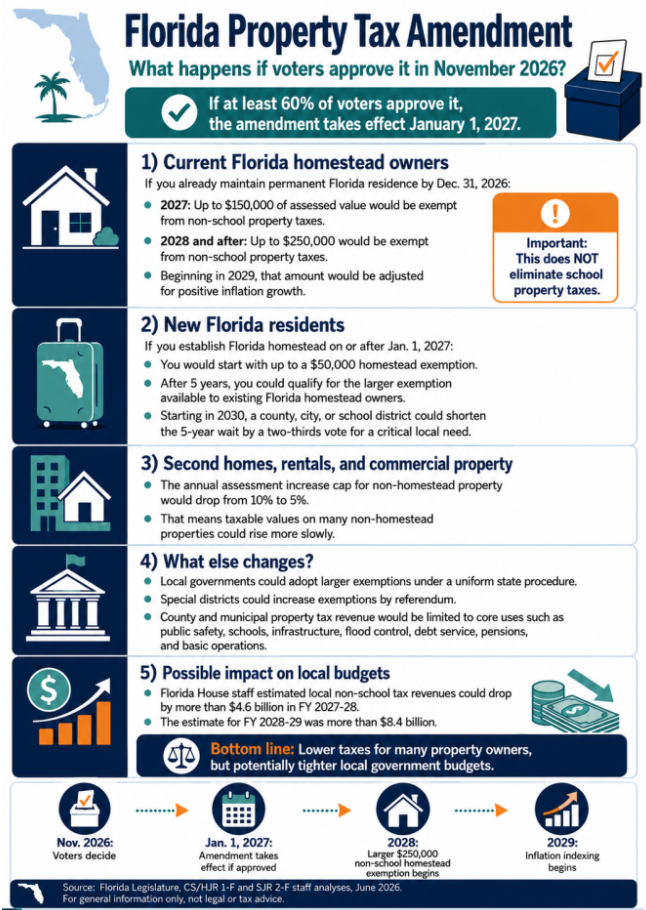
What the Amendment Proposes
Governor DeSantis and the Florida legislature have placed a constitutional amendment on the November 2026 ballot titled "Save Our Homes from Excessive Property Taxes." If passed with 60% voter approval, the amendment would gradually eliminate all non-school property taxes on primary homesteaded residences over a 10-year period beginning in 2027. Each year, the homestead exemption would increase by $100,000, so that by 2037, all homesteaded properties in Florida would be exempt from county, city, and special district taxes entirely. Homeowners would still pay the school district portion of their tax bill - roughly 35% to 40% of a typical total bill - but the remainder would be phased out entirely.
For a Palm Coast homeowner with a $350,000 taxable value paying roughly $5,000 per year in total property taxes today, this amendment could eventually reduce that bill to approximately $1,750 to $2,000 per year (the school portion only) by 2037. Barnes Walker law firm has published a detailed analysis of the amendment's structure and implications for Florida homeowners.
Who Would Benefit and Who Would Not
The amendment applies only to primary homesteaded residences. It does not apply to second homes, vacation homes, short-term rental properties, investment properties, or commercial buildings. If you are buying in Palm Coast as a full-time permanent resident and you plan to homestead the property, you would benefit from the phased elimination if the amendment passes. If you are buying as a part-time resident, second home owner, or investor, the amendment does not help you directly - though the broader economic impact on Florida's tax environment may still affect property values and demand.
For buyers considering investment properties or short-term rentals in the Flagler Beach area, read our guide to Flagler Beach short-term rental investing in 2026 for a full breakdown of carrying costs.
The Critical Residency Deadline for Buyers Moving to Florida
This is the most time-sensitive element of the amendment for buyers currently living outside Florida. The proposal includes a requirement that any person who establishes Florida residency after January 1, 2027 must maintain Florida residency for up to five years before qualifying for the full increased homestead exemption. In plain terms: if you move to Palm Coast and establish homestead before December 31, 2026, you qualify immediately if the amendment passes. If you wait until 2027 or later, you may face a waiting period of up to five years before receiving the full benefit.
This deadline is not guaranteed - the amendment still requires 60% voter approval in November 2026. But for buyers who are already considering relocating to Palm Coast and are deciding between this year and next, this potential residency cutoff is a meaningful factor in the timing calculus. Consult a Florida real estate attorney for guidance specific to your situation.
Real Numbers - What Property Taxes Look Like on a Palm Coast Home in 2026
Here is a practical example that puts the full system together for a typical Palm Coast buyer in 2026. Assume you are purchasing a Palm Coast home for $385,000 and it will be your primary residence.
Purchase price: $385,000. First-year assessed value (market value reset): $385,000. Homestead exemption (all taxes): minus $25,000 = $360,000 school taxable value. Second exemption (non-school): minus $25,000 additional = $335,000 non-school taxable value. Using an estimated school millage of 6.2 mills and non-school millage of 9.5 mills, your estimated first-year tax bill is approximately $360,000 x 0.0062 + $335,000 x 0.0095 = $2,232 + $3,183 = $5,415. If you do not file homestead in time for the first year, the same home at full millage of 15.7 mills with no exemption would cost approximately $6,045. The exemption saves you roughly $630 in year one.
By year five, with the Save Our Homes cap at 3% and a home that has appreciated in market value, your assessed value might be $410,000 while a new buyer would start at $420,000 or more. The gap widens every year, compounding your tax savings over time. This is why long-term homeowners in Florida pay far less in property taxes relative to their home's actual value than recent buyers - and why the SOH cap is the most powerful tax benefit in the Florida system for owners who stay put.
To explore the communities where these numbers apply, see our listings for Shelter Cove, Sunset Inlet, The Ritz Carlton Residences, and new construction homes in Palm Coast.
According to FlaglerLive reporting on 2026 taxable values, property values in Palm Coast and Flagler County declined for the first time in 14 years in 2026 (excluding new construction), which may translate to slightly lower assessed values and tax bills for some homeowners going into the 2027 cycle. For buyers, this represents a potential entry-point advantage worth discussing with your agent.
See also our guide on whether now is a good time to buy in Flagler Beach and Palm Coast.
Frequently Asked Questions: Palm Coast Property Taxes and Homestead Exemption
Will my property taxes be the same as what the current owner is paying?
Almost certainly not. When you purchase a home, the assessed value resets to market value and the previous owner's Save Our Homes cap does not transfer to you. Your first-year tax bill will be based on your purchase price minus your homestead exemption (if you file in time). If the previous owner had a large SOH differential built up over many years, your bill could be significantly higher than theirs.
When do I apply for homestead exemption in Flagler County?
You must file your homestead application with the Flagler County Property Appraiser by March 1 of the year you want the exemption to take effect. You must own and occupy the home as your primary residence as of January 1 of that year. If you close in the fall of 2026, you need to file by March 1, 2027 to have the exemption applied to your 2027 tax bill. Your 2026 tax bill will not include the exemption regardless of when you close.
What documents do I need to apply for homestead exemption?
You will need a Florida driver's license or state ID with your new property address, a Florida vehicle registration showing the new address, and proof of ownership such as your recorded deed. The Flagler County Property Appraiser's office at (386) 313-4150 can walk you through the complete list for your specific situation.
What is portability and do I qualify?
Portability lets you transfer your accumulated Save Our Homes benefit from a previous Florida homestead to your new Palm Coast home, reducing your taxable assessed value from day one. You qualify if you previously had a Florida homestead exemption on another property, abandoned that homestead within the last three years, and are establishing a new Florida homestead. You must apply for portability at the same time you apply for your new homestead exemption, by March 1.
How much does the homestead exemption save me per year?
At a combined millage rate of approximately 15 mills, the full $50,000 homestead exemption saves roughly $625 to $750 per year compared to a non-homesteaded property. The exact savings depend on your specific millage rate, which varies by location within Palm Coast. The Save Our Homes cap provides additional long-term savings that grow every year you own the home.
Should I wait until 2027 to buy in Palm Coast given the tax amendment vote?
The amendment on the November 2026 ballot includes a residency provision that may require buyers who establish Florida homestead after January 1, 2027 to wait up to five years for the full benefit if the amendment passes. For buyers who are already planning a move to Palm Coast, establishing homestead in 2026 potentially locks in immediate eligibility. However, the amendment still requires 60% voter approval, so it is not guaranteed. Consult a Florida real estate attorney and your financial advisor before making timing decisions based on the amendment outcome.
Does the property tax elimination amendment apply to rental properties?
No. The proposed amendment applies only to primary homesteaded residences. Investment properties, short-term rentals, vacation homes, second homes, and commercial buildings are not covered and would continue to be taxed at current rates.
What is the Palm Coast City millage rate for 2026?
Palm Coast City Council approved a maximum millage rate of 4.2296 for the 2026-2027 budget cycle. This is the city portion only and does not include county, school, or special district levies. The final adopted rate may be lower. For your total millage rate, look up the specific parcel on the Flagler County Tax Collector's website.
Work With a Palm Coast Agent Who Can Walk You Through the Real Numbers
Property taxes, homestead exemptions, portability, and the 2026 ballot amendment are not just background information - they are real dollars that affect what you can afford and when you should buy. The right agent helps you model the total cost of ownership before you make an offer, not after you close.
At The Landmark Group at Compass, we specialize in Palm Coast and Flagler Beach real estate. We help buyers find the right property in the right community - whether that is waterfront homes, new construction, Shelter Cove, Sunset Inlet, or home and lot packages - and we make sure you understand every cost before you sign.
Call us at (386) 338-3908 or visit landmarkgroupfla.com to connect with our team today.
Sources
- Flagler County Property Appraiser - Save Our Homes Assessment Cap
- Flagler County Tax Collector - Property Taxes
- AskFlagler - Palm Coast City Council Approves Maximum Millage Rate of 4.2296
- FlaglerLive - Property Values Fall for First Time in 14 Years in Palm Coast and Flagler
- Momentum Realty - Flagler County Homestead Exemption Guide 2026
- Barnes Walker - Florida Property Tax Elimination: 2026 Ballot Proposals
- Florida Governor's Office - DeSantis Announces Save Our Homes Property Tax Elimination Proposal
- Observer Local News - Palm Coast Approves Maximum Property Tax Rate After 4-1 Vote