
Blog > Why Your Zestimate Is Wrong | Flagler Beach Home Values
Why Your Zillow Zestimate Is Wrong in Flagler Beach, and What Your Home Is Actually Worth
Almost every seller we sit down with has already looked. They pulled up their address on Zillow, saw a number, and started building a plan around it. Sometimes they are thrilled. Sometimes they are deflated. Either way, that number is now the anchor for every conversation that follows.
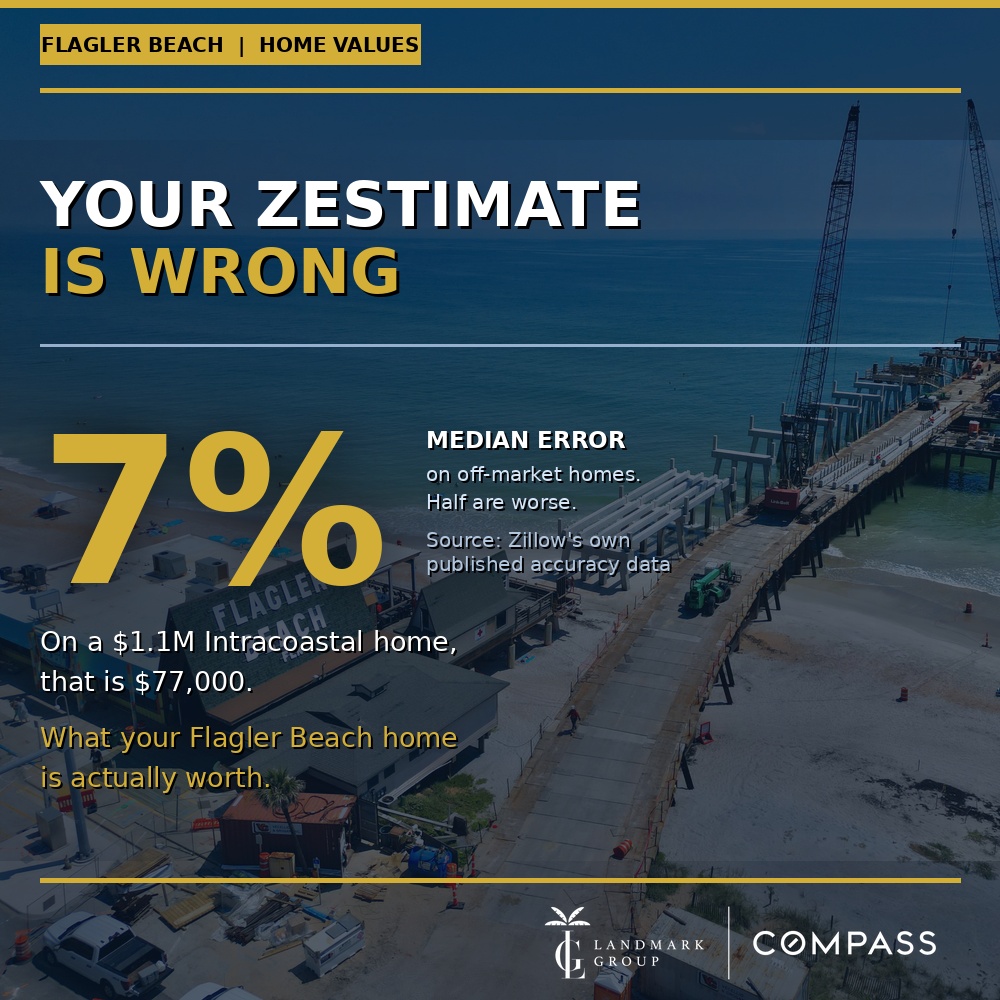
Here is the part Zillow does not put in front of you: by their own published accuracy data, half of all Zestimates on homes that are not currently listed are off by more than 7 percent. On a typical Flagler County home, that is a swing of about $26,000. On a waterfront property, it can be several times that.
And Flagler Beach happens to be one of the harder markets in Florida for an algorithm to price correctly. This is not a knock on Zillow. It is a structural problem with what automated valuation models can and cannot see, and it shows up sharply in a town where the house across the street can be worth double yours for reasons no database records.
What Zillow Itself Publishes About Zestimate Accuracy
Give Zillow credit: they publish their error rates openly. Most sellers simply never look at them.
| Home status | National median error | What that means |
|---|---|---|
| On the market (actively listed) | roughly 2.4% | Close. Nearly 70% land within 5% of the eventual sale price. |
| Off the market (not listed) | roughly 7% | Half of all estimates miss by more than 7%. Many miss by far more. |
If you are reading this and thinking about selling, your home is off market. You are in the second row.
The Catch Hidden Inside the On-Market Number
The 2.4 percent figure looks reassuring, and sellers often cite it. But there is a mechanical reason it looks so good: once a home is listed, the Zestimate adjusts toward the list price.
Think about what that means. The algorithm gets more accurate after a human being, usually an agent, has already done the work of pricing the home. The model is not independently predicting the sale price at that point. It is partly following a number someone else set.
So the accuracy statistic that matters to you, before you list, is the off-market one. About 7 percent, nationally, in an average market.
Four Reasons Zestimates Break Down Here Specifically
1. There Are Not Enough Comparable Sales
An automated model needs recent, similar, nearby sales. That is the whole engine. Take that away and it is guessing.
Look at the actual size of the communities in this market:
| Community | Total homes or units |
|---|---|
| Sunset Inlet | 31 homes |
| Shelter Cove | 44 homesites |
| Country Club Harbor | 52 homesites |
| Seaside Landings | 103 homesites |
| Le Jardin at Hammock Dunes | 26 residences |
| Viscaya at Hammock Dunes | 24 residences |
| Las Brisas | 8 residences |
In a community of 31 homes, a normal year might produce one or two sales. In an 8-unit building, you can go years with none. When the model cannot find true comps, it reaches outward, grabbing sales from communities that are nothing like yours. A canal home with a dock gets valued partly off inland ranch houses a mile west, because those are the sales that exist.
That is where a five and six figure error comes from.
2. Flood Zone and Elevation Are Invisible to the Model
This is the big one in Flagler Beach, and it cuts both directions.
Two homes on the same street, built the same year, similar square footage. One sits in Zone X. The other is in Zone AE, three feet below the Base Flood Elevation, with a flood insurance premium several thousand dollars a year higher. Those homes do not sell for the same price. Buyers price that difference in, because their lender makes them.
The Zestimate does not know your elevation certificate exists. It does not know whether your first floor sits above or below BFE, whether you carry an assumable NFIP policy at a grandfathered rate, or whether your neighbor's premium tripled under Risk Rating 2.0.
Industry analysis consistently finds that automated estimates skew low on waterfront property because flood risk uncertainty drags the surrounding comp set down. If you own something on the water here, there is a reasonable chance your Zestimate is under-reporting your value, and you would never know it. For the full picture on how zones work here, see our guide to Flagler Beach flood zones and flood insurance.
3. Oceanfront, Canal and Inland Are Three Different Markets
Flagler Beach sits on a narrow barrier island. Cross A1A and the economics change completely. Cross the Intracoastal and they change again.
The spread is not subtle. Entry-level oceanfront condos in this stretch of coast start around $650,000. Oceanfront single-family homes generally begin near $2 million. Intracoastal lots run from roughly $250,000 up past $1.5 million for prime deepwater. Inland residential lots in Palm Coast can start under $75,000.
Meanwhile the median price per square foot across Flagler Beach as a whole is about $297. That single blended number describes almost no individual house accurately. An algorithm leaning on citywide averages will systematically misprice both ends of that range. Browse A1A oceanfront properties and waterfront homes and the spread becomes obvious quickly.
4. Condition, Renovations and Hardening Do Not Show Up
Public records know your square footage, your bed and bath count, and your year built. They do not know:
- That you put on a new roof in 2023, which materially changes what an insurer will charge the next owner
- That you added impact windows and shutters
- That your kitchen was gutted and redone, or that it is original 1988
- That your dock was rebuilt after the last storm, or that it still needs to be
- Which direction your view faces, and whether anything can ever be built in front of it
In a coastal market, wind mitigation features are not cosmetic. They move insurance premiums, and insurance premiums move what a buyer can afford to pay. None of that reaches the model.
What a 7 Percent Error Actually Costs in This Market
Run the math against real local numbers. Flagler County's median sale price in July 2026 was in the $360,000 to $371,000 range depending on the source.
| Home value | 7% error equals | Realistic Flagler waterfront error |
|---|---|---|
| $370,000 (county median) | about $25,900 | often more |
| $650,000 (entry oceanfront condo) | about $45,500 | frequently higher on low-comp buildings |
| $1,100,000 (Intracoastal home with dock) | about $77,000 | this is where the errors get large |
That is the median error, not the worst case. Half of estimates miss by more than that.
The Two Ways a Wrong Number Costs You Real Money
If the Zestimate Reads High and You Price to It
This is the more common and more expensive mistake right now, and the current data shows it happening across the county.
As of mid-2026, roughly 22.7 percent of Flagler County listings have cut their price, and homes are averaging about 106 days on market, up from 92 a year ago. Inventory is actually down more than 20 percent year over year, so this is not a flood of competing listings. Fewer people are listing, and the ones who did are sitting.
That pattern points at pricing, not supply.
An overpriced listing burns its best weeks. The first two to three weeks generate the most showings you will ever get, and if the number is wrong, that traffic is wasted on buyers who leave without offering. Then come the reductions, and buyers who have watched the listing sit start reading the price drops as leverage. Homes that go through multiple cuts routinely close below what they would have brought if priced correctly on day one.
If the Zestimate Reads Low and You Believe It
Quieter, and arguably worse, because you never find out.
You accept an offer that felt fine against the Zestimate. Nobody tells you the identical floor plan three doors down with a rebuilt dock and impact glass closed thirty thousand higher last spring, because that sale never made it into the model's comp set. You leave the money on the table and move on, never knowing it was there.
Waterfront owners are the most exposed to this, for exactly the flood-zone reason above.
So What Is Your Home Actually Worth?
The honest answer is that nobody can tell you from a database, including us. What we can do is something an algorithm structurally cannot.
What Goes Into a Real Comparative Market Analysis
- Genuinely comparable sales. Not just nearby, but similar in flood zone, water access, view and construction. In small communities that sometimes means going back further in time and adjusting, rather than grabbing whatever sold last month a mile away.
- Your flood zone and elevation. Including whether you have an elevation certificate, and whether your NFIP policy is assumable by a buyer. That last point is worth real money to the right buyer and no model tracks it.
- Condition and improvements, seen in person. Roof age, windows, HVAC, dock condition, kitchen and bath updates.
- What is actually on the market against you right now, and how long it has been sitting. Active competition sets your ceiling more than closed sales do.
- Insurance reality for the next owner. In this market, a buyer's premium quote can make or break the deal. Knowing yours before you list is an advantage.
- Tax reset math. Buyers coming from out of state are often surprised when assessed value resets on purchase. Our guide to Palm Coast property taxes and the homestead exemption explains how that works.
What to Have Ready
You do not need any of this to get started, but each item sharpens the number:
- Your elevation certificate, if you have one
- Your current flood and homeowners insurance declarations
- Roof age and any wind mitigation report
- A list of improvements with rough dates
- Survey and any dock permits
Frequently Asked Questions
How accurate is a Zestimate, really?
Zillow publishes a national median error of roughly 2.4 percent for homes currently listed for sale, and roughly 7 percent for homes that are not listed. Since your home is off market while you are deciding whether to sell, the 7 percent figure is the relevant one. Median means half of all estimates are worse than that.
Why is my Zestimate so different from my neighbor's?
Usually because the model has more or better comparable sales for one of you than the other, or because it has different public record data on file. Small differences in recorded square footage, bed and bath counts, or lot size can move the number significantly, and public records are not always correct.
Is my Zestimate too low because I am on the water?
Possibly. Automated valuations tend to run low on waterfront property because flood risk uncertainty pulls the comparable set down. If you own on a canal or the Intracoastal in Flagler Beach, it is worth having the number checked by someone who can account for your specific zone, elevation and water access.
Can I update my Zestimate myself?
You can claim your home on Zillow and correct facts like square footage, bed and bath count and renovations, which sometimes moves the estimate. It is worth doing. It will not fix the underlying comp problem in a small community, and it will not teach the model about your flood zone.
Should I just price my home at the Zestimate?
No. Right now about 22.7 percent of Flagler County listings have already cut their price and homes are averaging 106 days on market, up from 92 a year ago, while inventory is down more than 20 percent year over year. That combination points to pricing problems rather than oversupply. Pricing off an automated number is how listings end up in that group.
Does a low Zestimate hurt me when I list?
It can, because buyers see it too and some treat it as a negotiating anchor. The practical answer is to be able to explain, with specific comparable sales, why the number is wrong. That is a conversation worth having before you go live, not after.
What is the difference between a Zestimate, a CMA and an appraisal?
A Zestimate is an automated estimate from public data. A comparative market analysis is prepared by an agent who has seen the property and selected the comps by hand. An appraisal is a formal opinion of value by a licensed appraiser, usually ordered by a lender, and it is the one that has to satisfy the buyer's loan.
How much does it cost to find out what my home is worth?
Nothing. A market analysis from our team is free and carries no obligation to list. If the answer is that now is not your moment, we will tell you that.
Get an Actual Number for Your Flagler Beach Home
We have sold in Flagler Beach and Palm Coast for twenty years, across oceanfront, canal, Intracoastal and inland. We know which sales are genuinely comparable to yours and which ones just happen to be nearby.
Request a free home valuation and we will walk your property, pull the real comps, factor in your flood zone and insurance picture, and give you a number you can actually plan around. No obligation, and no pressure to list.
Get your free home valuation or call (386) 338-3908.
Thinking further ahead? See our guide to selling in Flagler Beach and Palm Coast and the current Flagler Beach Real Estate Market Report.
Sources
- Zillow published Zestimate accuracy data, national median error rates for on-market and off-market homes, 2026
- Redfin - Flagler County Housing Market (median sale price, days on market)
- GoToby - July 2026 and YTD Housing Report (median price, inventory, months of supply)
- Momentum Realty - Flagler County Market Data (active listings, price cut percentage)
- Redfin - Flagler Beach Housing Market (median price per square foot)
- Hammock Dunes Owners' Association (unit counts for Le Jardin and Viscaya)
- Landmark Group at Compass community data (Sunset Inlet, Shelter Cove, Seaside Landings, Country Club Harbor, Las Brisas)